Our land
High desert. Rimrock, sage flats, juniper on the benches, and a long dry country that reads cold at the end of the day.
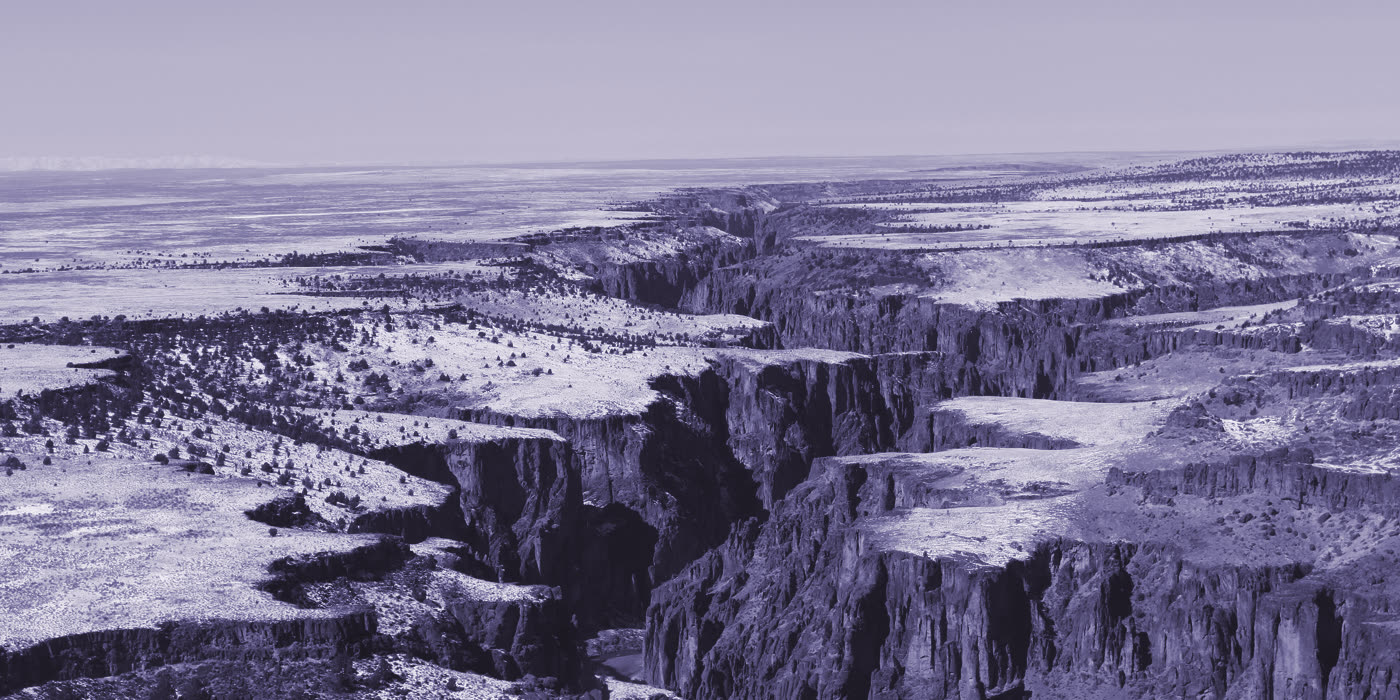
The Nation’s country is high desert: sage flats broken by rimrock, juniper on the benches, and washes that run hard for two days a year and are dry the rest of it.
Four communities sit on it. Dry Fork is the seat of government and the largest. North Bench, Alkali Draw and Sand Bench are smaller, and each elects a Council member.
The Nation holds roughly 44,000 acres of range, which Sand Bench Cattle Company runs under permit, and a four megawatt solar array on the south bench. The water claim that Chairwoman Marsh has been negotiating with the state for six years concerns the wash system and the aquifer beneath it.
About these photographs
These photographs are not this Nation’s land, because this Nation has no land. Tribal Nation 2 is invented.
They are public domain scenery photographed on federal public land by the Bureau of Land Management, and they have been colour graded to this site’s palette. They were chosen under a rule worth stating plainly:
A fictional Nation must never be dressed in a real Nation’s country.
That rule ruled out the obvious choices. Nearly every recognizable formation in the Southwest belongs to a living Nation, and even a federal refuge named after a Nation was rejected here, because putting a real Nation’s name in the credits for invented scenery is the same mistake wearing a different coat.
What is left is anonymous: unnamed rimrock, unnamed sage flat, a horizon with
nothing recognizable on it. Sources and licences are recorded in full at
/media/CREDITS.md.
When a real Nation builds this site, their own photographs drop into these same slots.
Where the language goes
This site is built with a place for the Nation's own language in the masthead, in the greeting on the home page, and above the heading of every major section. Each of those places is empty.
We do not invent Indigenous words and we do not run English through a translator. A language belongs to its speakers. What a design studio can honestly do is build the space, set it at the same size and weight as the English so it reads as an equal line and not as decoration, and then leave it alone.
The fields are there in the editor at /admin and a staff
member fills them in the same way they would fill any other field. A
heading with nothing in that field simply shows the English, which is
what you are reading now.